▋ Technological Forecasting & Social Change
Who's ready for AI? The strategic leader–employee confidence divide and its economic and cultural contexts
Caini Tenga, Xiao Tanga, Zhengwen Liub, Zhe Dengc,*
a School of Public Policy & Management, Tsinghua University, 100084, Chinab School of Economics, Peking University, 100871, Chinac Beijing Academy of Science and Technology, 100012, China
Highlights
-
•
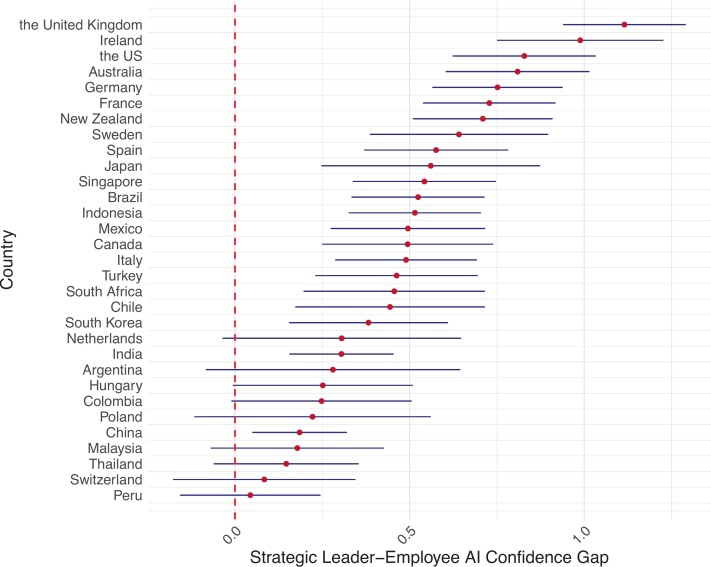
We identify a robust strategic leader-employee AI confidence gap using cross-country microdata.
-
•
Strategic leaders (business owners and senior executives) are systematically more optimistic about AI than employees.
-
•
The gap is wider in service-oriented and individualistic countries, but narrower in contexts with greater power distance.
-
•
We suggest that context-sensitive governance is critical for inclusive AI diffusion.
Abstract
AI adoption is a socio-technical transformation, shaped by how organizational actors perceive and assess its potential benefits and risks. While group differences in AI confidence are widely noted, the vertical divide within organizations, specifically between strategic leaders and employees, remains underexplored, despite its implications for organizational transformation and socially inclusive AI diffusion. Using cross-country microdata from the Ipsos AI Monitor 2024 (N = 23,685; 32 countries) and applying country fixed-effects and multilevel models, we provide the first empirical evidence of a robust leader-employee confidence gap and examine how it varies across national economic and cultural contexts. The gap reflects asymmetric and position-based AI sensemaking: strategic leaders tend to view AI through an organization-wide augmentation frame, which is centered on enterprise value, expanded managerial capacity, and reinforced authority. Employees, by contrast, are closer to frontline implementation and therefore more directly exposed to automation-related risks, including task substitution, job insecurity, and reduced autonomy. Consistent with this mechanism, the gap is larger in service-oriented and more individualistic societies, but smaller in contexts with greater power distance. These findings highlight that AI confidence is socially embedded in organizational hierarchy and national context, and caution that AI diffusion may encounter internal organizational frictions under divergent expectations. The study thereby underscores the need for inclusive and context-sensitive governance, transparent communication, employee participation, and proactive strategies to build social adaptability during AI transformation.
Keywords
AI confidence
;
Strategic leader-employee divide
;
Organizational hierarchy
;
AI diffusion
;
Inclusive adoption